



You open the dishwasher expecting clean dishes, but instead the display is showing two mysterious letters. IE? OE? AE? LE? The machine may beep, stop mid-cycle, or refuse to start. Before assuming the dishwasher needs an expensive repair, check what the code actually means. Many LG dishwasher problems are related to water supply, drainage, detergent, or simple installation issues. However, some codes point toward components that need professional attention. LG also warns that error and notification codes can vary by model, so your owner’s manual remains the final reference for model-specific codes.
Quick Summary
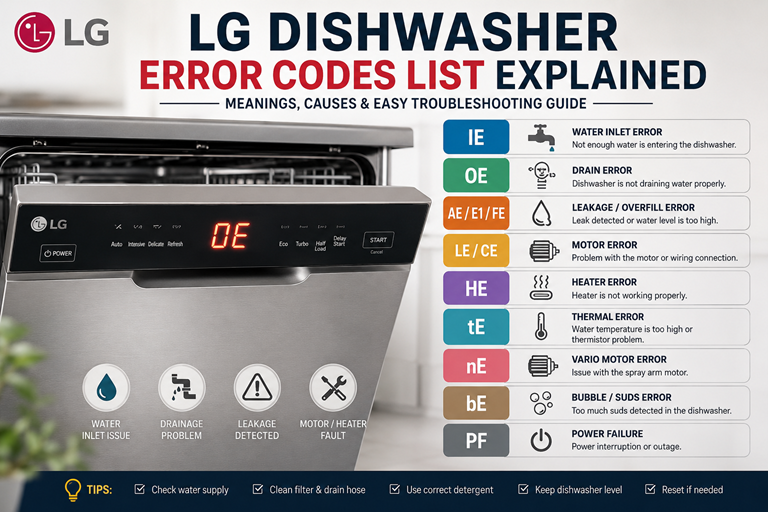
- IE usually indicates a water inlet or filling problem.
- OE means the dishwasher is not draining properly.
- AE/E1/FE can indicate leakage, overfilling, or excessive sudsing, depending on the model.
- LE/CE generally points to a cleaning motor or motor-related problem on applicable models.
- HE indicates a heater problem.
- tE indicates a thermal or temperature-sensing problem.
- nE indicates a Vario motor or pump-related issue on applicable models.
- bE commonly relates to excessive sudsing or an incorrectly leveled dishwasher.
- PF indicates a power interruption and is not necessarily a fault.
- Codes such as CL, 2H, delay-hour numbers, and rinse-aid settings may be notifications rather than actual errors.
What Do LG Dishwasher Error Codes Mean?
An LG dishwasher uses display codes to communicate when it detects an operating problem or when a particular feature has been activated. Think of the code as a starting point rather than a complete diagnosis.
For example, an OE code does not necessarily mean the drain pump has failed. LG says an OE condition can be caused by clogged filters, food debris, drainage problems, a kinked drain hose, or installation-related issues.
Likewise, an IE code does not automatically mean the inlet valve needs replacing. A closed water valve, kinked hose, clogged inlet filter, or insufficient water pressure can prevent the dishwasher from receiving enough water.
That distinction matters. Replacing a part before checking the simple causes can turn a five-minute maintenance job into an unnecessary repair bill.
Why Can the Same LG Dishwasher Code Have Different Causes?
LG produces many dishwasher models, and the control systems and features differ between them. The company explicitly notes that error and notification codes can vary depending on the product model.
So if your display shows a code that does not appear in a general list, do not assume the dishwasher is malfunctioning. Locate the exact model number and consult the corresponding LG documentation.
LG Dishwasher Error Codes List: Meaning and Possible Causes
The following list covers common LG dishwasher codes and the first things worth checking.
IE — Water Inlet Error
IE generally means the dishwasher has not received enough water during the filling process.
Possible causes include:
- Closed household water-supply valve
- Kinked or pinched inlet hose
- Clogged inlet valve filter
- Low water pressure
- Incorrectly connected water supply
LG’s current troubleshooting guidance specifically recommends checking the water supply, hose condition, valve, inlet filter, and water pressure when an IE code appears.
Start by making sure the water valve under the sink is fully open. Then inspect the visible portion of the inlet hose. If it is sharply bent behind the dishwasher, water flow may be restricted.
OE — Drain Error
OE means the dishwasher has detected a drainage problem.
This is one of the more practical codes to troubleshoot yourself. LG identifies food debris, clogged filters, drain problems, a blocked air gap, garbage-disposal connection issues, and a kinked drain hose among possible causes.
First remove standing water if necessary and inspect the dishwasher filter. Clean away food particles and other debris. Check the drain hose for bends or compression. If your dishwasher drains through a sink air gap or garbage disposal, those connections should also be checked.
LG’s July 2026 guidance says cleaning the filter, straightening the drain hose, and checking the air gap and garbage disposal can often resolve an OE problem before service is required.
AE / E1 / FE — Leakage or Overfilling
Codes in this group can be associated with leakage, excessive water, or overfilling, depending on the model.
LG explains that AE/E1 can occur when the dishwasher detects a leak and activates its float switch. Excessive sudsing can also cause water to overflow.
Check the door gasket for food buildup, grease, cracks, or other damage. Also inspect the spray arms and make sure the dishwasher is properly leveled.
Detergent deserves special attention. Using ordinary hand dishwashing liquid can create excessive foam because it is not formulated for an automatic dishwasher. LG specifically advises against using dishwashing liquid in the appliance.
If water is present in the base of the dishwasher, do not simply keep restarting it. The underlying leak needs to be identified.
LE / CE — Motor Error
LE or CE can indicate a motor-related problem on applicable LG dishwasher models.
LG’s troubleshooting documentation says the issue may involve the motor itself or the wiring harness connecting the motor and control board. A basic power reset may sometimes clear a temporary fault.
Turn the dishwasher off, disconnect power according to the manufacturer’s safety instructions, wait briefly, restore power, and try a new cycle. If the code returns, repeated resets are unlikely to solve the underlying problem and service may be necessary.
HE — Heater Error
HE indicates a heating-related problem.
The heater is responsible for raising water temperature during the appropriate part of the wash cycle and supporting drying functions on applicable models. If the HE code continues to appear after basic troubleshooting, LG recommends professional service.
Because heating components involve electrical connections and high temperatures, this is not a good area for trial-and-error part replacement.
tE — Thermal Error
A tE code indicates a thermal error. LG states that it can occur when water temperature becomes excessively high or when there is a problem with the thermistor, the component used to sense temperature.
If the code repeatedly returns, stop treating it as a simple reset issue. A technician may need to test the temperature-sensing and heating system.
nE — Vario Motor Error
The nE code is associated with the Vario motor on applicable LG dishwasher models.
LG describes this motor as part of the system controlling the dishwasher’s spray-arm operation. If the nE code persists, professional inspection may be required.
This is different from an OE drain error. The dishwasher may have water entering and leaving normally while still experiencing a problem with the mechanism responsible for spray-arm operation.
bE — Bubble or Oversudsing Error
A bE code can appear when excessive suds are detected.
The first question to ask is simple: What detergent did you use?
Never substitute ordinary hand-washing dish soap for automatic dishwasher detergent. Excess foam can interfere with normal operation and may contribute to leakage. LG also notes that an improperly leveled dishwasher can contribute to bE conditions.
If the machine is level and you are using the correct detergent but bE continues to appear, the issue may require service.
PF — Power Failure
PF looks like an error code, but it usually indicates a power interruption rather than a dishwasher component failure.
LG explains that the dishwasher can display PF after an outage or interruption and may remember where it was in the cycle. The code can clear after restoring normal power and restarting the appliance.
If PF appears frequently without obvious power outages, investigate the electrical supply rather than repeatedly resetting the dishwasher.
Which LG Dishwasher Codes Are Not Actually Errors?
Not every unusual display message means something is broken. This is where many troubleshooting searches go wrong.
For example, LG identifies 2H as an estimated-time indicator. It means less than two hours remain in the cycle; it is not a repair code.
Other displays can represent settings or operating information:
- CL — Child Lock or Control Lock on applicable models
- 01–24 — Delay Start hours
- I-24, H-01, H-02 — Delay-wash settings on applicable models
- n, u, d — Controller/version information
- — — Cancel function activated
- L0–L4 — Rinse-aid level setting
LG’s support documentation specifically distinguishes these notifications from actual fault codes.
That means the first step is always to identify exactly what the display says and whether the appliance is actually refusing to operate.
How to Troubleshoot an LG Dishwasher Error Code Safely
Once you know the code, avoid immediately searching for replacement parts. Start with basic checks that do not require opening electrical components.
1. Check the water supply
For an IE code, verify that the water-supply valve is open and that the inlet hose is not bent or pinched. If the dishwasher was recently installed or moved, incorrect hose routing deserves extra attention.
2. Inspect the filter and drain area
For OE, remove visible food debris and clean the dishwasher filter according to the model’s instructions. Check the drain hose and, where applicable, the sink air gap or garbage-disposal connection.
3. Look for signs of leakage
For AE or E1, check around the door gasket, tub, spray arms, and accessible base area for water. A dishwasher that has detected a leak may continue draining as a protective measure.
4. Verify the detergent
Use only detergent designed for automatic dishwashers. Too much detergent can create excessive suds, particularly under certain water conditions. Hand dish soap should never be used in place of dishwasher detergent.
5. Make sure the dishwasher is level
An improperly leveled appliance can contribute to drainage, door-sealing, and sudsing-related problems. LG recommends proper leveling for reliable operation.
6. Reset only when appropriate
A power reset can sometimes clear a temporary electronic condition. It should not be treated as a permanent repair for a recurring IE, OE, AE, LE, HE, tE, or nE problem.
If the same code immediately returns after the recommended checks, there is a good reason to investigate further rather than repeatedly resetting the appliance.
When Should You Call a Dishwasher Technician?
Some problems are reasonable for homeowners to inspect. Others are better left to a qualified technician.
Call for professional service when:
- A leak continues after obvious causes have been eliminated.
- AE/E1 repeatedly returns.
- LE/CE returns after a proper power reset.
- HE or tE continues to appear.
- nE repeatedly returns.
- The dishwasher makes unusual motor or pump noises.
- There is a burning smell, damaged wiring, or evidence of electrical overheating.
- The circuit breaker repeatedly trips.
- The error code is not documented for your specific model.
- You need to remove or test internal electrical components.
A recurring error is useful diagnostic information. If the dishwasher keeps showing the same code, record when it happens, what cycle was running, whether water was entering or draining, and whether anything unusual happened immediately beforehand. That information can make service considerably more efficient.
For electrical or internal component problems, do not remove covers or work on live wiring simply because an online troubleshooting guide suggests a component might be responsible.
Why Your LG Model Number Matters
A general LG dishwasher error codes list is useful for identifying likely causes, but it cannot replace the manual for your exact appliance.
LG’s own support pages state that codes can differ by product model. Features such as Dynamic Heat Dry or Auto Open Door can also introduce model-specific codes. LG’s current guide, for example, documents codes such as F31, F35, and F37 for applicable models.
Before ordering a part, find the dishwasher’s complete model number. It is typically located on a product label around the door or inner frame, although the exact location varies.
Then compare the displayed code with the official documentation for that model.
This small step prevents a common mistake: assuming that two LG dishwashers displaying similar-looking codes necessarily use the same troubleshooting procedure or replacement part.
Frequently Asked Questions About LG Dishwasher Error Codes
What is the most common LG dishwasher error code?
There is no single error code that applies universally to every LG dishwasher. IE commonly relates to water supply, while OE indicates a drainage problem. The exact meaning and available codes depend on the dishwasher model.
How do I clear an OE error on an LG dishwasher?
Turn the dishwasher off, then check for food debris, a clogged filter, a kinked drain hose, and problems around the air gap or garbage-disposal connection. Clean the filter and correct obvious drainage restrictions before testing another cycle.
Why does my LG dishwasher show AE or E1?
AE or E1 can indicate that the dishwasher has detected leakage or an overfill condition, depending on the model. Excessive sudsing, door-seal problems, improper leveling, and actual leaks are possible causes.
Is PF on an LG dishwasher a serious error?
Usually, no. PF indicates a power interruption and is generally a notification rather than a component failure. If it repeatedly appears without power interruptions, however, the electrical supply should be investigated.
Conclusion
An LG dishwasher error code is best viewed as a diagnostic clue, not a verdict that your appliance needs replacement. Start with the basics: water supply for IE, drainage for OE, leaks and suds for AE/E1, and detergent and leveling where relevant. Codes involving motors, heating, or temperature sensing deserve more caution, especially when they return after a reset.
Most importantly, match the code with your exact LG dishwasher model before buying parts or attempting repairs. LG itself notes that error and notification codes vary between models, making model-specific documentation the safest source for the final diagnosis.