



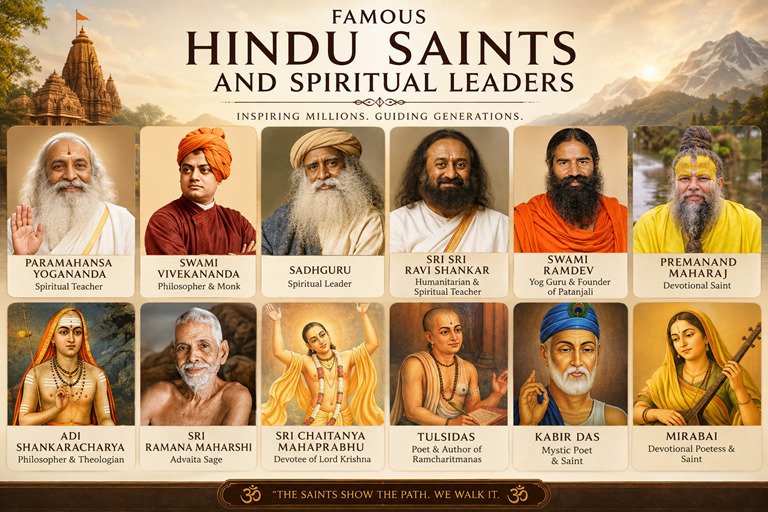
Walk through almost any part of India and you will encounter a story about a saint, guru, mystic, poet, or wandering monk whose influence outlived generations. Some transformed Hindu philosophy, others expressed devotion through poetry and music, while modern spiritual teachers have taken Indian traditions to international audiences. This guide to famous Hindu saints and spiritual leaders in India brings together influential figures from different periods and traditions, while recognizing that the word “saint” is understood differently across Hindu communities.
Quick Summary
- Adi Shankaracharya is remembered for systematizing Advaita Vedanta and strengthening monastic traditions.
- Ramanuja shaped Vishishtadvaita Vedanta and emphasized loving devotion to a personal God.
- Chaitanya Mahaprabhu helped popularize devotional worship of Krishna through congregational chanting.
- Mirabai, Kabir and Tulsidas brought spiritual ideas into accessible poetry and devotional literature.
- Ramakrishna Paramahansa and Swami Vivekananda profoundly influenced modern interpretations of Hindu spirituality.
- Ramana Maharshi became internationally known for the practice of self-inquiry.
- Swami Prabhupada established ISKCON and helped spread Gaudiya Vaishnava teachings globally.
- Bhagwan Swaminarayan combined spiritual teaching with social reform in western India.
- Modern teachers such as Sri Sri Ravi Shankar and Sadhguru have introduced yoga, meditation and Indian spiritual ideas to contemporary audiences.
1. Adi Shankaracharya: A Major Voice of Advaita Vedanta
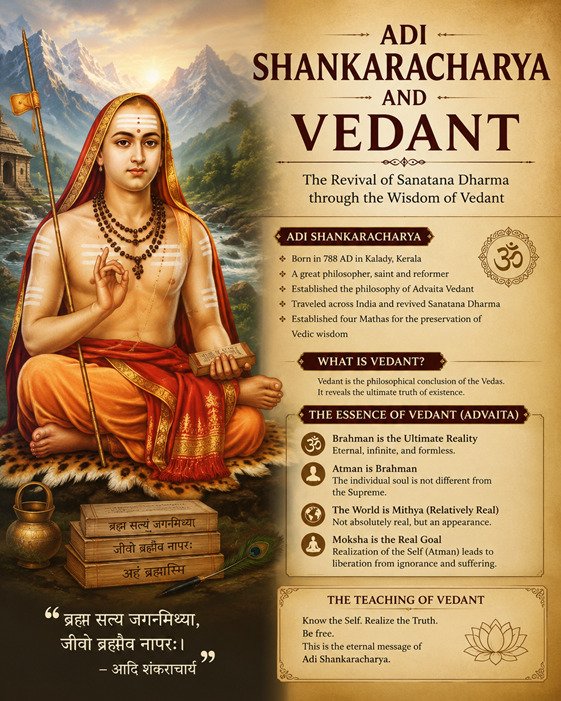
Adi Shankaracharya is one of the most influential philosophers in the history of Hindu thought. Traditionally dated to the early medieval period, he is associated with Advaita Vedanta, the non-dualistic school that teaches that the deepest reality, Brahman, is non-dual and that the individual self is ultimately not separate from it.
His influence goes beyond philosophical texts. Traditional accounts credit Shankaracharya with extensive travel across India, debates with scholars of different schools and the establishment or consolidation of monastic institutions associated with the Dashanami tradition.
What makes Shankaracharya especially significant is the combination of intellectual rigor and spiritual practice in his legacy. His works discuss Upanishadic teachings, the Bhagavad Gita and the nature of liberation, but his influence also lives through living monastic traditions.
For readers interested in Hindu philosophy, Shankaracharya is an essential starting point for understanding Advaita Vedanta, Brahman, Atman and moksha.
Why he remains influential
His teachings continue to shape contemporary discussions about consciousness, self-knowledge and non-duality. Advaita also became an important bridge between classical Hindu philosophy and modern spiritual conversations about the nature of the self.
2. Ramanuja: The Philosopher of Devotion and Vishishtadvaita
Ramanuja, generally dated to the 11th–12th century, developed Vishishtadvaita Vedanta, often translated as “qualified non-dualism.” His philosophical approach differed significantly from Shankara’s Advaita.
For Ramanuja, devotion to a personal God—especially Vishnu and his manifestations—was central to spiritual life. His interpretation of Vedanta connected philosophical inquiry with bhakti, or loving devotion.
That combination helped make his legacy particularly important within Vaishnavism. Rather than presenting spirituality as purely an intellectual pursuit, Ramanuja emphasized surrender, devotion and a relationship with the divine.
His influence can still be seen in Sri Vaishnava traditions and temples across India.
Key contribution: Ramanuja helped establish a philosophical framework in which devotion and Vedantic knowledge could coexist rather than being treated as competing approaches.
3. Chaitanya Mahaprabhu: The Saint Who Made Bhakti a Public Experience
Chaitanya Mahaprabhu, associated with 16th-century Bengal and Odisha, became one of the most important figures in the Gaudiya Vaishnava tradition.
His spiritual movement centered on intense devotion to Krishna and the communal chanting of divine names, known as sankirtana. Instead of restricting spiritual expression to scholars or specialists, the movement emphasized singing, chanting, dancing and collective devotion.
His legacy is particularly important because it helped create a devotional culture that was emotionally expressive and accessible to ordinary people.
The modern International Society for Krishna Consciousness (ISKCON) traces its philosophical lineage through the Brahma-Madhva-Gaudiya sampradaya and identifies Chaitanya’s teachings on congregational chanting as an important part of its tradition.
Chaitanya’s influence therefore extends well beyond the historical period in which he lived. His devotional tradition eventually became part of a global Vaishnava movement.
4. Mirabai: The Rajput Princess Who Became a Devotional Icon
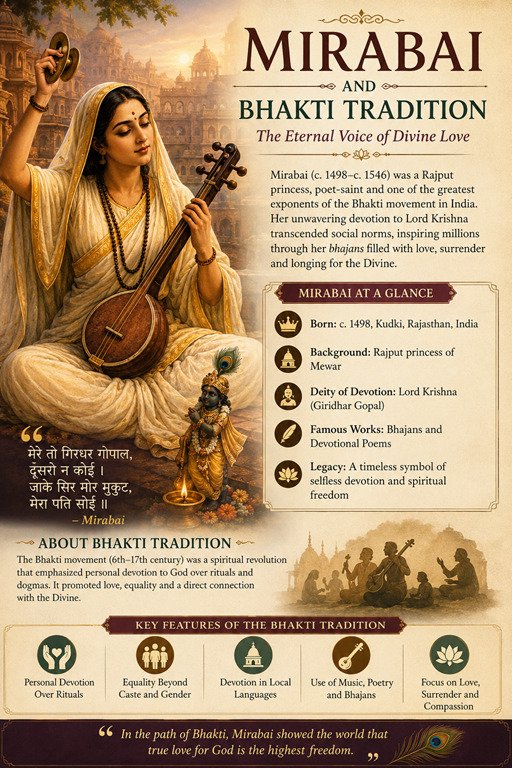
Mirabai, usually known simply as Meera, is among India’s best-known women saints and devotional poets.
Associated with Rajasthan and the Krishna-bhakti tradition, Mirabai’s poetry expresses an intensely personal relationship with Krishna. Her songs portray devotion not as an abstract philosophical concept but as something deeply emotional, intimate and life-changing.
Stories about Mirabai often focus on her refusal to abandon her devotion despite opposition from members of the royal household into which she married. Some details of her biography are surrounded by centuries of hagiographical tradition, so individual stories should not automatically be treated as independently verified historical events.
Her enduring importance, however, is unmistakable.
Mirabai’s devotional songs continue to be performed across India, particularly in Rajasthan, Gujarat and North Indian bhakti traditions. Her legacy also stands out because she became a powerful cultural symbol of spiritual independence and unwavering devotion.
5. Kabir: A Poet Beyond Religious Boundaries
Kabir occupies a fascinating place in Indian spiritual history. Usually associated with the 15th century, he challenged empty ritualism, social divisions and religious narrowness through direct, often provocative poetry.
Although commonly included in lists of Indian saints, Kabir does not fit neatly into a simple Hindu category. His verses draw from and respond to Hindu and Islamic religious environments, while repeatedly directing attention toward inner realization rather than external labels.
That is precisely why his poetry remains relevant.
Kabir’s dohas are short, memorable and conversational. They question ego, hypocrisy and attachment while encouraging seekers to look inward. His influence extends across multiple devotional and religious communities.
For modern readers, Kabir offers a particularly useful lesson: spirituality can question the very identities people use to divide themselves.
6. Tulsidas: The Poet Behind a Living Ram Tradition
Tulsidas was a major poet and devotee associated with Lord Rama. His best-known work, the Ramcharitmanas, retells the story of Rama in Awadhi and became one of the most influential devotional works in North Indian religious culture.
The significance of Tulsidas goes beyond literature. By presenting the Rama story in a language accessible to a much wider audience than classical Sanskrit, he helped bring devotional storytelling into homes, temples, public performances and community traditions.
The Ramcharitmanas continues to influence religious festivals, Ramlila performances, devotional singing and popular understandings of Rama.
For anyone researching the relationship between Hinduism and Indian literature, Tulsidas is difficult to overlook.
7. Ramakrishna Paramahansa: A Modern Saint of Religious Harmony
Sri Ramakrishna Paramahansa lived from 1836 to 1886 and became one of the most influential Hindu mystics of nineteenth-century India.
His spiritual life was closely associated with the Dakshineswar Kali Temple near Kolkata. According to the Ramakrishna tradition, he practiced different spiritual disciplines and came to emphasize the underlying unity of religious paths.
The Ramakrishna-Vivekananda tradition describes his central contribution as a message of harmony among religions rather than the creation of a new religious sect.
This idea later became enormously influential through his disciple Swami Vivekananda.
Ramakrishna’s importance in modern Hindu thought lies partly in this meeting of intense personal mystical experience and an expansive view of religious pluralism.
8. Swami Vivekananda: The Monk Who Took Vedanta to the World
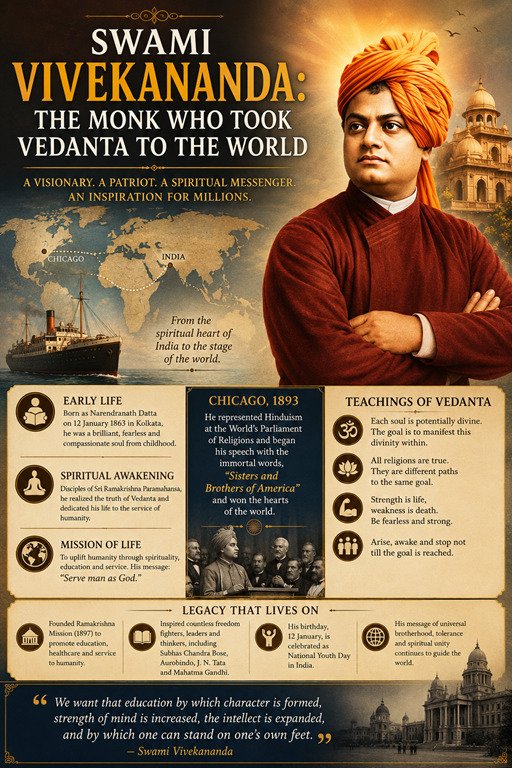
Few Indian spiritual leaders have had a more visible international impact than Swami Vivekananda.
Born Narendranath Datta in 1863, Vivekananda became a disciple of Ramakrishna and later emerged as a major interpreter of Vedanta for modern audiences.
His appearance at the 1893 World’s Parliament of Religions in Chicago introduced many Western audiences to a powerful presentation of Hindu philosophy. His subsequent lectures and writings helped establish Vedanta as a subject of serious interest outside India.
But Vivekananda’s legacy was not simply about philosophy.
He argued strongly for education, strength, social responsibility and service to humanity. His teachings helped shape the Ramakrishna Mission, whose work includes education, healthcare, disaster relief and other forms of social service. The Ramakrishna-Vivekananda tradition describes this approach as seeing service to people as a form of worship.
For many Indians, Vivekananda represents a distinctive combination of spirituality, national awakening and practical service.
9. Ramana Maharshi: The Sage of Self-Inquiry
Ramana Maharshi is one of the best-known spiritual figures associated with twentieth-century Advaita.
Based at Arunachala in Tamil Nadu for much of his life, Ramana Maharshi became known for emphasizing self-inquiry, particularly the question “Who am I?”
Rather than presenting spiritual growth primarily as an accumulation of beliefs, his teaching directed seekers toward examining the source of the sense of individual identity.
This makes Ramana particularly appealing to contemporary readers interested in meditation and non-dual awareness. His ashram at Tiruvannamalai continues to attract visitors and spiritual seekers from India and around the world.
His teaching is also a good reminder that Indian spirituality cannot be reduced to rituals alone. Philosophical inquiry, meditation, silence and direct investigation of consciousness have long been part of India’s spiritual traditions.
10. Bhagwan Swaminarayan: Spiritual Teaching and Social Reform
Bhagwan Swaminarayan, born in 1781, became the founder of the Swaminarayan Sampradaya and an important religious figure in Gujarat.
According to BAPS historical material, he left home at the age of 11 and undertook a seven-year pilgrimage across India before settling in western India. His movement combined devotional practice with moral discipline and social reform.
His legacy includes the Vachanamrut, temple traditions and a large network of spiritual and social institutions.
The Swaminarayan tradition also places strong emphasis on service. Contemporary BAPS activities include education, healthcare, environmental initiatives, community development and social welfare.
This combination of spirituality and community service is one reason the Swaminarayan tradition remains highly visible in India and among the Indian diaspora.
11. A.C. Bhaktivedanta Swami Prabhupada: Taking Krishna Bhakti Global
A.C. Bhaktivedanta Swami Prabhupada founded the International Society for Krishna Consciousness, better known as ISKCON, in 1966.
His mission centered on the teachings of the Bhagavad Gita and Srimad Bhagavatam, devotional service to Krishna and the practice of congregational chanting. ISKCON describes itself as continuing the Brahma-Madhva-Gaudiya tradition associated with Chaitanya Mahaprabhu.
Prabhupada’s importance lies partly in his ability to communicate classical Vaishnava teachings to a twentieth-century international audience.
From a small beginning in New York, ISKCON developed into a worldwide movement with temples, vegetarian restaurants, educational activities, publications and devotional communities.
Whether one approaches his work as religion, philosophy or cultural history, his global impact on the visibility of Krishna bhakti is substantial.
12. Sri Sri Ravi Shankar: Meditation, Breathwork and Humanitarian Service
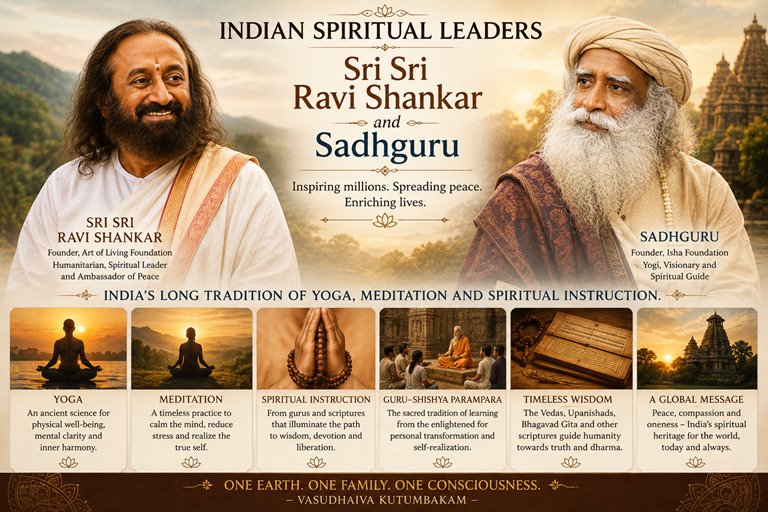
Among contemporary Indian spiritual leaders, Gurudev Sri Sri Ravi Shankar has built one of the most internationally recognizable spiritual organizations.
Born in 1956, he founded The Art of Living, an organization focused on meditation, breathwork, personal development and humanitarian initiatives. The organization identifies him as a spiritual teacher and humanitarian leader whose work promotes a stress-free and violence-free society.
His approach has brought practices such as Sudarshan Kriya into mainstream conversations about meditation, stress management and wellbeing.
Unlike the traditional image of a secluded Himalayan sage, Sri Sri Ravi Shankar represents a distinctly modern model of spiritual leadership: large-scale courses, international programs, humanitarian projects and public engagement.
13. Sadhguru: A Contemporary Voice on Yoga and Inner Wellbeing
Sadhguru, born Jagadish Vasudev, is another prominent contemporary Indian spiritual teacher. He founded the Isha Foundation and is known internationally for teaching yoga, meditation and inner wellbeing.
His public communication combines traditional yogic ideas with discussions of education, environment, social development and contemporary life. His official biography describes his approach as one that does not treat spirituality and science as simple opposites.
His influence illustrates how the role of the Indian guru has changed in the digital age. Spiritual teachings that once depended heavily on physical ashrams and personal encounters can now reach global audiences through books, videos, social platforms and online programs.
At the same time, contemporary spiritual figures should be evaluated thoughtfully rather than simply placed on the same historical footing as medieval saints. Their institutions, public claims and social impact belong to a different cultural context.
14. Premanand Maharaj: A Contemporary Voice of Radha-Krishna Bhakti
Premanand Maharaj, widely known as Pujya Shri Premanand Govind Sharan Ji Maharaj, is a contemporary Hindu spiritual teacher associated with Vrindavan, Uttar Pradesh, and the devotional tradition centered on Radha and Krishna. He has become particularly well known among younger audiences through spiritual discourses, devotional teachings and widely shared online videos.
His teachings place strong emphasis on Radha-Krishna bhakti, remembrance of the divine name, spiritual discipline, humility and devotion in everyday life. His public discourses frequently address practical questions about relationships, family responsibilities, personal struggles, meditation, devotion and the role of spiritual practice in ordinary life.
One reason for his growing popularity is the accessibility of his communication. Rather than discussing spirituality only through abstract philosophical concepts, his talks often respond to questions that people encounter in daily life. This has helped his teachings reach audiences far beyond traditional temple and ashram settings.
Premanand Maharaj’s connection with Vrindavan, one of the most important pilgrimage centers associated with Krishna devotion, is also central to his public identity. His teachings are rooted strongly in the devotional culture of Braj, where remembrance of Radha and Krishna forms a major part of religious life.
His rise illustrates how Hindu spiritual teaching is changing in the digital era. Historically, seekers often encountered a guru through a temple, pilgrimage, satsang or personal introduction. Today, a single discourse can reach millions of viewers through digital platforms.
Why Premanand Maharaj is influential among younger seekers
Premanand Maharaj has developed a significant following among people looking for accessible guidance on bhakti, spiritual discipline and personal conduct. His popularity also reflects the continuing appeal of traditional devotional teachings in an environment where spiritual content is increasingly consumed online.
Like other contemporary spiritual teachers, his influence should be understood within the specific religious tradition and community surrounding him rather than measured only by social-media visibility. His growing public presence nevertheless makes him an important figure to include in a 2026 overview of contemporary Hindu spiritual leaders.
What Do These Saints and Spiritual Leaders Have in Common?
At first glance, these figures seem remarkably different.
Shankaracharya emphasized philosophical non-duality. Ramanuja developed a devotional interpretation of Vedanta. Mirabai expressed personal love for Krishna through poetry. Kabir questioned religious labels. Vivekananda promoted service and Vedantic philosophy. Ramana Maharshi emphasized self-inquiry, while modern teachers often combine meditation with practical wellbeing.
Yet several themes appear repeatedly.
1. Self-knowledge
The question of who we really are appears throughout Indian philosophical and spiritual traditions. Whether expressed through Vedanta, meditation, devotion or self-inquiry, inner transformation remains a recurring goal.
2. Bhakti and devotion
For saints such as Mirabai, Chaitanya and Tulsidas, love and surrender toward the divine were not secondary practices. They were central paths to spiritual realization.
3. Service
Vivekananda’s legacy is particularly notable for connecting spirituality with organized social service. Modern Hindu institutions have continued this idea through schools, hospitals, relief programs and community initiatives.
4. Questioning social and religious assumptions
Kabir challenged hypocrisy and sectarian divisions. Swaminarayan’s tradition emphasized moral reform and opposition to harmful social practices. Different saints approached reform differently, but many refused to accept spiritual life as mere ritual without ethical transformation.
Why Are Hindu Saints Still Relevant in 2026?
The popularity of these figures is not limited to religious history.
People continue to search for practical answers to questions about stress, purpose, identity, morality, meditation and the nature of consciousness. The teachings of Indian saints offer multiple approaches rather than a single formula.
Someone drawn to philosophy may begin with Shankaracharya or Ramana Maharshi. A devotee may connect more strongly with Mirabai, Chaitanya or Tulsidas. Someone interested in service may find Vivekananda’s example particularly compelling. Modern seekers may encounter Sri Sri Ravi Shankar or Sadhguru through meditation and yoga programs.
That variety is arguably one of the defining characteristics of India’s spiritual heritage.
It also explains why lists of “the greatest” Hindu saints should be treated cautiously. Spiritual importance is often shaped by region, sampradaya, language and personal devotion. A saint who is central to one tradition may be far less prominent in another.
Frequently Asked Questions
Who is the most famous Hindu saint in India?
There is no universally accepted single “most famous” Hindu saint. Figures such as Adi Shankaracharya, Mirabai, Ramakrishna, Swami Vivekananda, Ramana Maharshi and Chaitanya Mahaprabhu have achieved exceptional influence, but recognition varies by tradition and region.
Who are the most famous Hindu spiritual leaders today?
Among prominent contemporary Indian spiritual leaders are Sri Sri Ravi Shankar and Sadhguru, alongside leaders of established Hindu traditions such as the Swaminarayan and Vaishnava communities. Their teachings and institutions have substantial national and international reach.
Who was the greatest saint of India?
There is no objective answer. “Greatest” depends on the criteria used—philosophical influence, devotional impact, social reform, literary contribution or international reach. Shankaracharya, Mirabai, Kabir, Vivekananda and Ramana Maharshi are among the many figures frequently regarded as exceptionally influential.
What is the difference between a Hindu saint, guru and spiritual leader?
A saint generally refers to a person regarded as spiritually realized or exceptionally holy. A guru is traditionally a spiritual teacher who guides disciples. “Spiritual leader” is broader and can describe people who lead religious institutions, movements or contemporary spiritual organizations.
Who are the most famous Hindu spiritual leaders today?
Prominent contemporary Hindu spiritual leaders include Sri Sri Ravi Shankar, Sadhguru and Premanand Maharaj, as well as leaders associated with established Hindu traditions and institutions. Their influence varies by tradition, region, audience and international reach.
Conclusion
India’s spiritual history is not a single straight line. It is a vast network of philosophies, devotional movements, teachers, poets, monks and reformers. From Shankaracharya’s Advaita Vedanta to Mirabai’s devotion, Kabir’s fearless poetry, Vivekananda’s service-oriented spirituality and the meditation movements of contemporary teachers, each figure offers a different way of approaching the questions at the heart of spiritual life.
For readers exploring these traditions in 2026, the best approach is not to ask which saint was “the greatest,” but what each teacher actually taught—and how those teachings continue to shape Indian religious and cultural life today.